
Adding a gate to your property is one of the best investments an Arizona homeowner can make. It adds security, curb appeal, and property value all at once. But gates come in a wide range of styles, materials, and operation types — and the right choice depends on your property, your priorities, and your HOA.
Swing Gates vs. Sliding Gates
The first decision is how your gate will move. Both types work well, but the right choice depends on your driveway layout.
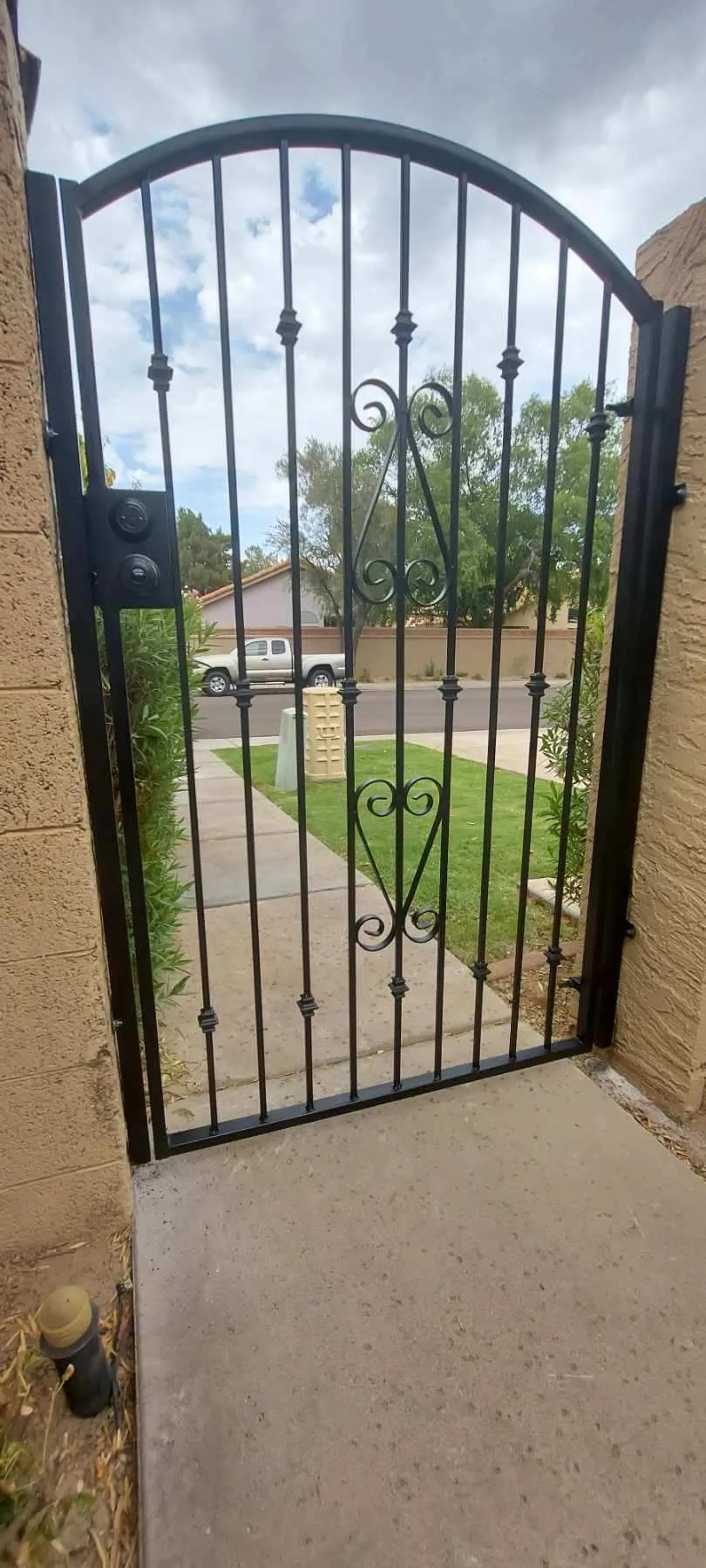
Swing gates open inward or outward like a door. They are the most common residential style and work well on flat driveways with enough clearance for the gate panels to swing open. A double-swing configuration — two panels meeting in the center — is the standard for most driveways. Single-swing works for pedestrian gates and narrow side entries.
The main limitation of swing gates is space. They need a clear arc to open, which can be a problem on sloped driveways, short driveways, or properties where landscaping is close to the gate line.
Sliding gates move horizontally along a track or rail. They are ideal for sloped driveways, tight spaces, or wide openings where swing panels would be impractical. A sliding gate needs clear run space along the fence line — roughly equal to the width of the opening. Cantilever sliding gates eliminate the ground track entirely, which reduces maintenance in Arizona where dirt and debris accumulate quickly.
Gate Materials
Wrought iron is the most popular material for residential gates in Arizona and for good reason. It is strong, durable, and available in a huge range of designs from simple vertical pickets to elaborate scrollwork. Modern wrought iron gates are hot-dip galvanized and powder-coated to resist rust — important in our climate where irrigation spray and monsoon moisture are factors. Expect wrought iron to last 20 years or more with periodic touch-up paint on any chips or scratches.
Steel offers similar strength to wrought iron at a lower cost. Flat steel panel gates are popular for modern and contemporary homes. Like wrought iron, steel needs a quality powder coat to handle Arizona conditions. Steel is also the go-to material for custom fabrication — if you need a gate built to specific dimensions for an HOA-compliant design, steel gives the fabricator the most flexibility.
Aluminum is lightweight and naturally corrosion-resistant, making it an excellent choice for Arizona. It will not rust even without a coating, though powder coating adds color and UV protection. Aluminum gates are easier to automate because they put less strain on the motor. The trade-off is that aluminum is softer than steel and less resistant to impact damage.
Wood delivers a warm, natural look that complements Southwestern and ranch-style homes. Cedar and redwood hold up best in dry climates. The reality is that wood gates in Arizona require regular maintenance — sealing or staining every one to two years to prevent cracking, warping, and UV damage. A wood-and-metal combination (wood panels in a steel frame) reduces maintenance while keeping the wood aesthetic.
Vinyl is the lowest-maintenance option. It will not rust, rot, or need painting. However, vinyl gates can become brittle in prolonged UV exposure and do not carry the same weight or feel as metal. Best for privacy fencing gates in side yards rather than front-facing driveway entries.
Automation Options
A manual gate works fine, but most homeowners who invest in a driveway gate want the convenience of automation. Here is what to consider.
Swing gate operators mount to the post and the gate panel. Articulated arm operators are the most common residential type — they are reliable, relatively quiet, and work with most swing gate styles. Underground operators hide the mechanism below grade for a cleaner look but cost more and are harder to service.
Slide gate operators mount at one end of the gate and drive it along the track using a chain or rack-and-pinion system. They handle heavier gates better than swing operators, which is why you see them on commercial properties. For residential sliding gates, a chain-drive operator is the standard.
Access control is the other half of automation. The simplest setup is a remote control transmitter — like a garage door opener. Keypad entry adds a code option for guests and service providers. Smartphone-based systems let you open the gate from anywhere, see who is at the gate via camera, and grant temporary access remotely. We install and service systems from LiftMaster, Genie, and Linear.
Safety features are required by code on automated gates. Photoelectric sensors detect objects in the gate’s path. Reversing mechanisms stop and reverse the gate if it contacts an obstruction. These are not optional — they protect people, pets, and vehicles.
HOA and Permit Considerations
Many Arizona HOAs have specific requirements for gate style, height, color, and material. Common restrictions include maximum heights (typically six feet for front-facing gates), approved colors that match the community palette, and prohibitions on certain materials or designs. Always check your CC&Rs before selecting a gate.
Building permits may also be required depending on your city and the scope of the installation. Mesa, Gilbert, and Chandler each have their own permitting requirements for gates — particularly automated ones that involve electrical work. We handle the permit process as part of our gate replacement service so you do not have to navigate it yourself.
What to Expect on Cost
Gate pricing varies widely based on material, size, style, and automation. A basic manual wrought iron swing gate starts around $1,500 installed. A fully automated sliding gate with access control and custom fabrication can run $5,000 to $10,000 or more. The biggest cost drivers are material (steel and iron cost more than aluminum), size (wider openings need larger motors and more material), and automation complexity.
We provide free in-home estimates so you can see exactly what your project will cost before committing. Schedule yours here or call us to talk through your options.